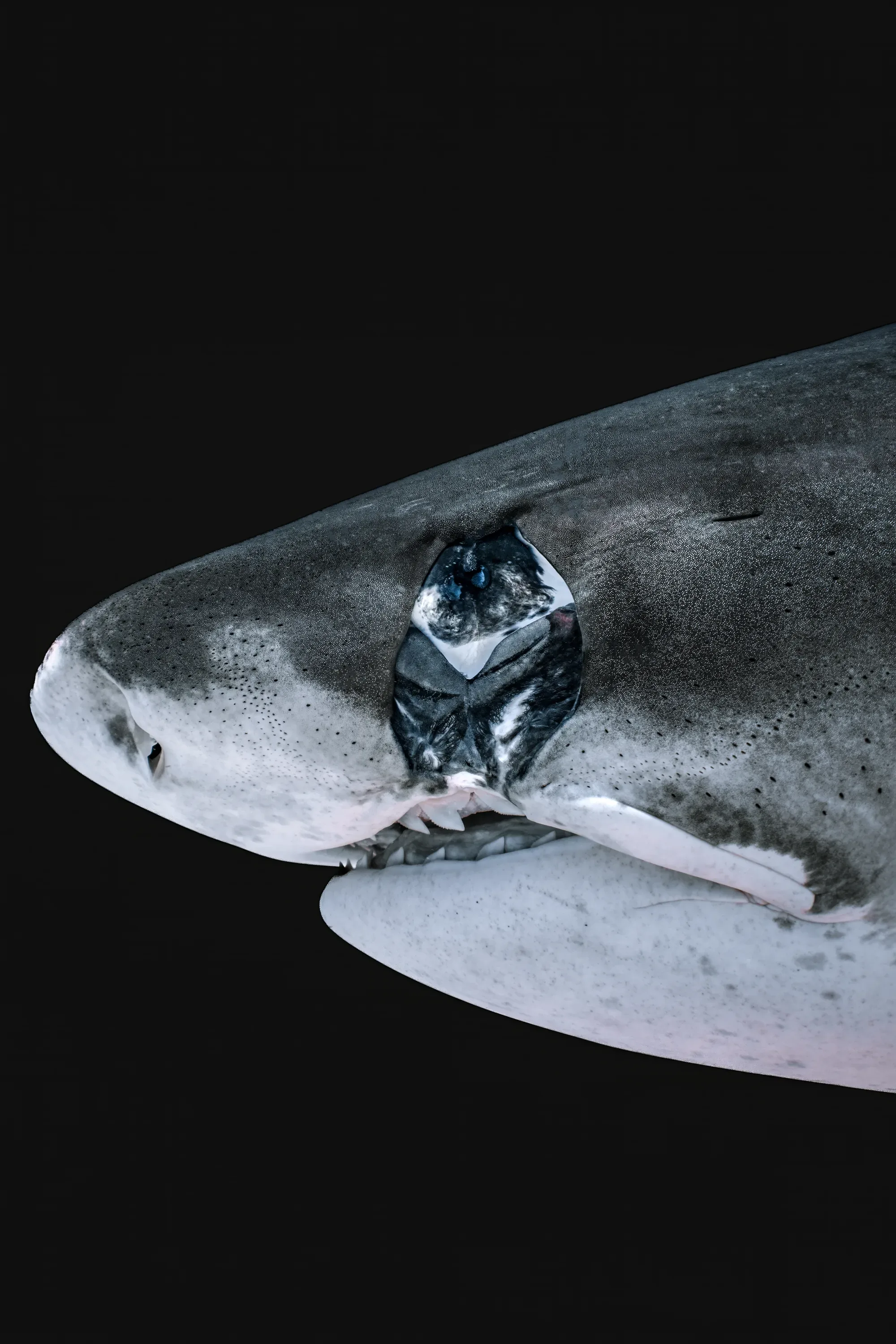
The places where sharks are recovering are almost always the places where they're worth more alive. Fuvahmulah is now the textbook example of that argument — and we are here because we want to keep it that way.
The Five-Point Pledge
This is what we commit to, in writing, on every dive we run.
We Never Hand-Feed
No exceptions. No photo opportunities that require it. Our protocol explicitly forbids hand-feeding because it conditions sharks to associate divers with food — and that's a problem we don't want to create.
Small Groups, Always
We cap our dives at a 1:3 guide-to-diver ratio. This costs us revenue. That is the point. A crowded dive is worse for the sharks and worse for everyone in the water.
Local Guides Only
Every guide on our team is from Fuvahmulah. Our captains, our instructors, our divemasters — all locals who grew up in these waters. This is the only way long-term shark protection actually works.
No Touching. No Chasing. No Flash.
Basic wildlife ethics apply underwater too. We do not touch sharks. We do not chase them. We do not use strong strobes. Our team enforces this in the water, every dive, without exception.
We Support the People Doing the Science
We don't run our own research programs. Instead, we work closely with local ocean NGOs and conservation partners — contributing dive observations, images, and ID data to the databases they maintain. The science is done by specialists; our role is to feed it.
We Don't Run the Science.
We Support the People Who Do.
Real ocean conservation needs specialists — researchers, biologists, NGOs with multi-year datasets. Our role is to contribute reliable field data from our daily dives, and to follow their lead. This is what our partnerships look like in practice.
Tiger Shark ID Database
Resident population research
Tiger Shark ID Database
Resident population research
We contribute every Tiger Harbour dive's encounters, ID photos, and behavioural notes to the shared Fuvahmulah tiger shark identification database — a long-running effort that tracks over 300 individual animals visiting the site. The database is maintained by local researchers; our role is to feed it with daily field data.
Whale Shark Conservation Partners
Whale shark monitoring & protection
Whale Shark Conservation Partners
Whale shark monitoring & protection
We work closely with whale shark conservation NGOs operating in the Maldives. Whenever our dives encounter whale sharks — at Fuvahmulah's southern sites or on transits — we log sightings, submit photo ID data, and support the long-term monitoring efforts that underpin protected-species policy in the region.
Local Ocean NGOs
Reef, species & community conservation
Local Ocean NGOs
Reef, species & community conservation
We partner with Maldivian ocean conservation organisations working on reef health, species protection, and community-led marine programs. Contribution looks different for each partnership — sometimes it's data, sometimes it's outreach, sometimes it's logistical support. The thread is the same: we follow the people doing the specialist work.
What We Contribute
Field Observations
Daily dive logs, encounter counts, behavioural notes, and site conditions — passed to the partners who track long-term trends.
Photo ID Data
High-resolution images used by researchers to identify individual tiger sharks, whale sharks, and other pelagics by natural markings.
Logistical Support
Boat access, guide time, accommodation for visiting researchers, and on-island coordination for partner projects.
Read more about the tiger sharks themselves on our Fuvahmulah tiger shark dive page.
How the Dive Actually Works
Transparent, step-by-step, no spin.
Arrival & Positioning
Divers settle on the sandy plateau at 6–8m, well back from the bait site. Group stays compact, stationary, and low.
Bait Placement
Tuna heads only — never marlin (too oily, over-stimulates). Placed under a pile of rocks at a fixed location, not thrown, not suspended, not held.
Passive Observation
Sharks arrive on their own schedule. Divers remain stationary. No movement toward the sharks, no attempt to interact, no flash photography.
Safety Team Control
Our safety divers maintain position between the group and the bait area throughout the encounter. They manage spacing and can end the dive if any individual shark behaves unusually.
Documentation
Every named shark that appears is logged in our database. Notes on behaviour, position, time of day, and conditions are captured for the long-term record.
Why This Protocol Exists
Fuvahmulah's tiger sharks have been feeding on fishermen's offcuts at the harbour entrance for generations. The site wasn't created by tourism — we joined a feeding pattern that predates us by decades. Our protocol exists to respect that pattern, not replace it. The sharks show up because they always have. We simply observe.
Why Conservation Works Here
Shark tourism isn't sentimentality. It is one of the strongest documented economic arguments for marine conservation anywhere in the world.
Revenue per reef shark per year (dive tourism)
~$30,000
Source: Maldives marine economic studies
One-time value of the same shark (fin trade)
~$50
Source: Market estimates
Global shark population decline, last 50 years
~70%
Source: IUCN Red List data
Shark fishing ban in the Maldives
2010
Source: National legislation
"The Maldives banned shark fishing in 2010 — a decision driven in large part by the obvious economic value of dive tourism. Today, the industry continues to prove, year after year, that protecting sharks pays."
— Liquid Shark Divers, Fuvahmulah
Built by Fuvahmulah Locals
Every member of our guide team is from this island. Our captains, our instructors, our divemasters, our crew — all locals who grew up in these waters and know the sharks like family. Many come from fishing families whose fathers and grandfathers worked the same harbour where the tiger shark dive happens today.
This is not a cosmetic decision. Dive tourism only protects marine life long-term when the economic benefit flows to the local community. Operators that fly in foreign staff and ignore local hiring undermine the entire conservation argument. We built LSD specifically to do the opposite.
100% Local Team
Every guide, captain, and instructor is from Fuvahmulah.
Fishing Heritage
Many team members come from multi-generational Fuvahmulah fishing families.
Community Partners
We work with local hotels, restaurants, and transport operators.
Long-Term Incentive
Local ownership creates the strongest possible incentive for protection.
How Diving with Us Helps
Data Contribution
Every dive adds to the shared shark ID databases and partner research programs we contribute to. Photos, behavioural notes, and encounter logs feed long-term research on Fuvahmulah's resident tigers and visiting whale sharks.
Economic Pressure
Every guest strengthens the argument that a living shark is worth more than a dead one. That argument is why the Maldives banned shark fishing. It only keeps working if divers keep showing up.
Voice & Influence
When you share your experience honestly, you help shift public perception of sharks. The fear-first narrative is what drives fishing. Stories like yours are the counter.