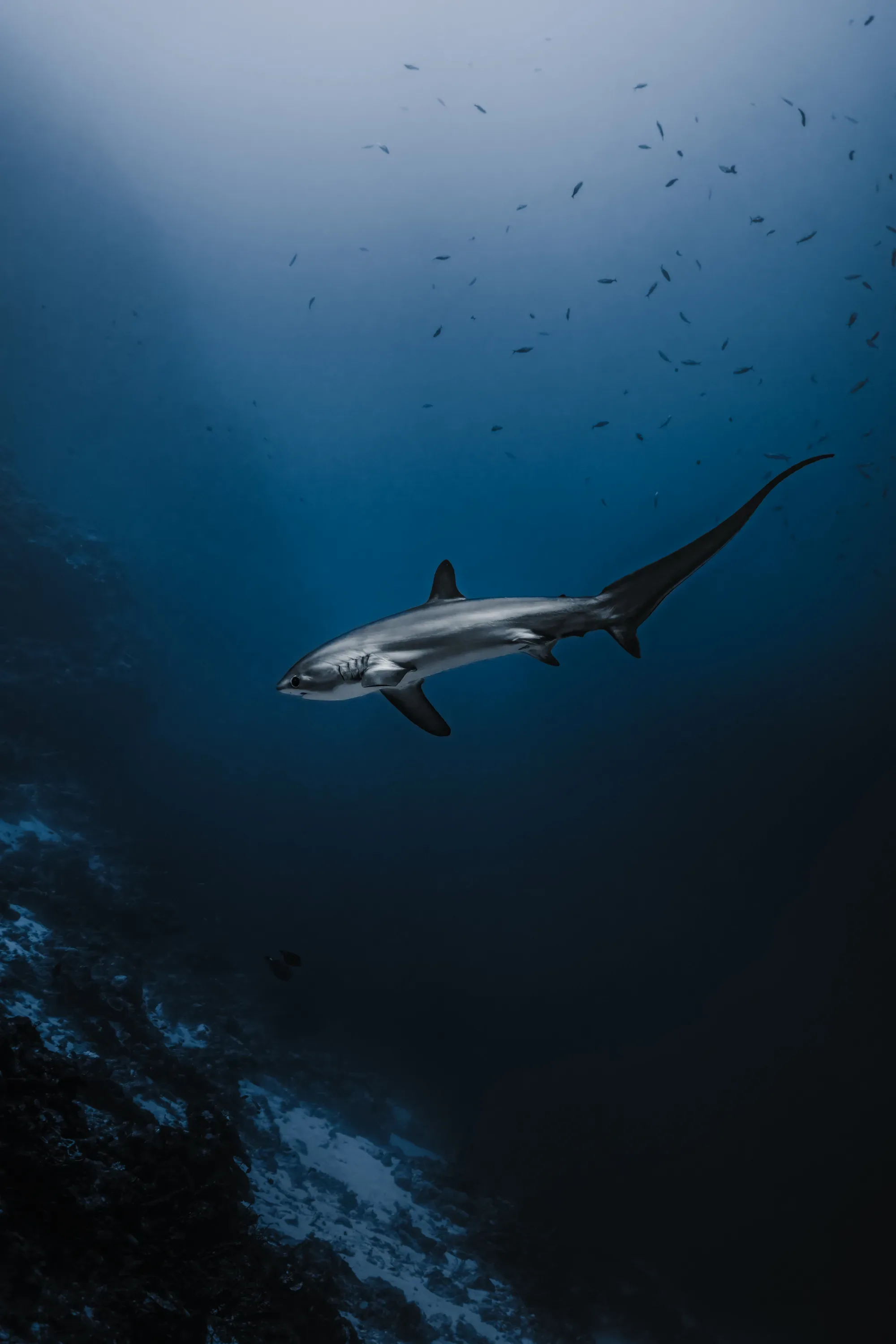
Diving with Thresher Sharks
in Fuvahmulah
Experience close encounters with the elusive Pelagic Thresher Shark at Fuvahmulah's exclusive cleaning stations. Discover the best dive sites, optimal dive times, and expert guidelines for observing these magnificent deep-sea hunters in the Maldives.
Why Fuvahmulah is the Thresher Capital
While most divers travel to the Philippines for Thresher Sharks, Fuvahmulah has quietly emerged as a world-class alternative, offering something unique: size and solitude.
Unlike typical viewing stations where encounters can be fleeting, the unique topography of Fuvahmulah—a solitary volcanic atoll rising vertically from 2,000m depth—creates upwellings that bring cleaning stations into accessible recreational depths (15m - 30m).
The "Pelagic Thresher" (Alopias pelagicus) found here is distinct. They are larger, bolder, and often seen in conjunction with other pelagic species like Hammerheads and Silvertips, making every drift dive a multi-species safari.
Tiger vs. Thresher
Tigers are curious and approach divers. Threshers are extremely shy. Sudden movements, bubbles, or chasing will cause them to vanish instantly. Passive observation is key.
Best Time of Day
Early morning (6:00 AM - 8:00 AM). As the sun rises higher, these deep-dwelling sharks retreat back into the dark depths (aphotic zone).
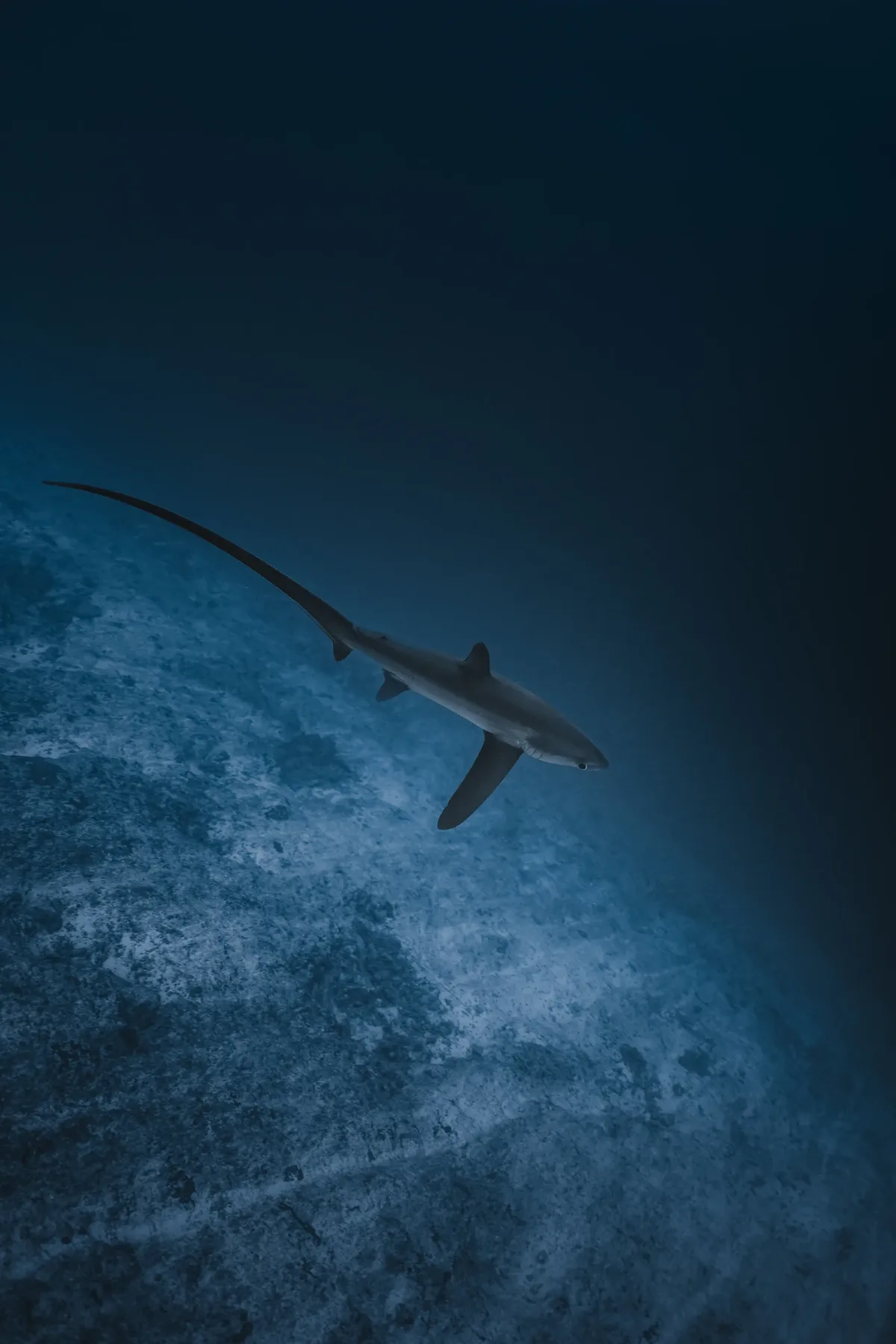
The Vertical Abyss
A Solitary Rock in the Deep Ocean
Fuvahmulah is geologically unique in the Maldives. It is a one-island atoll that rises vertically from the ocean floor, reaching depths of over 2,000 meters just a few hundred meters from shore.
This vertical wall acts as a barrier to the deep ocean currents, creating upwellings that bring nutrient-rich cold water to the surface. This phenomenon creates the perfect hunting ground for deep-sea predators like Threshers, who use the thermoclines (temperature layers) to regulate their body heat while hunting schooling squid and sardines.
Anatomy of a Hunter
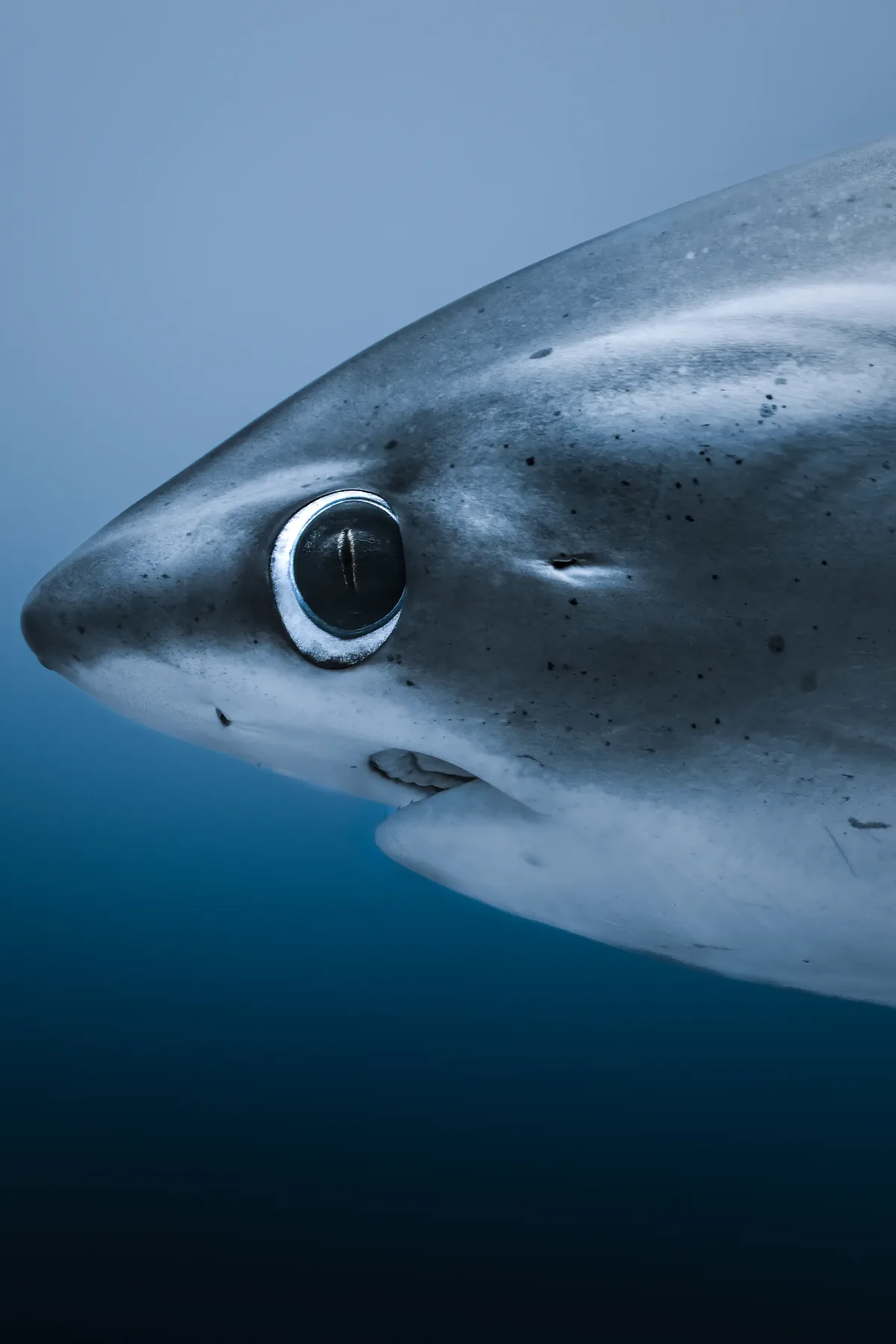
Distinct Features
- Large Eyes
Adapted for hunting in the dark, mesopelagic zone (200m+).
- Caudal Fin
The tail accounts for 50% of body length, used to stun prey.
- Endothermy
Capable of regulating body heat to stay active in cold deep water.
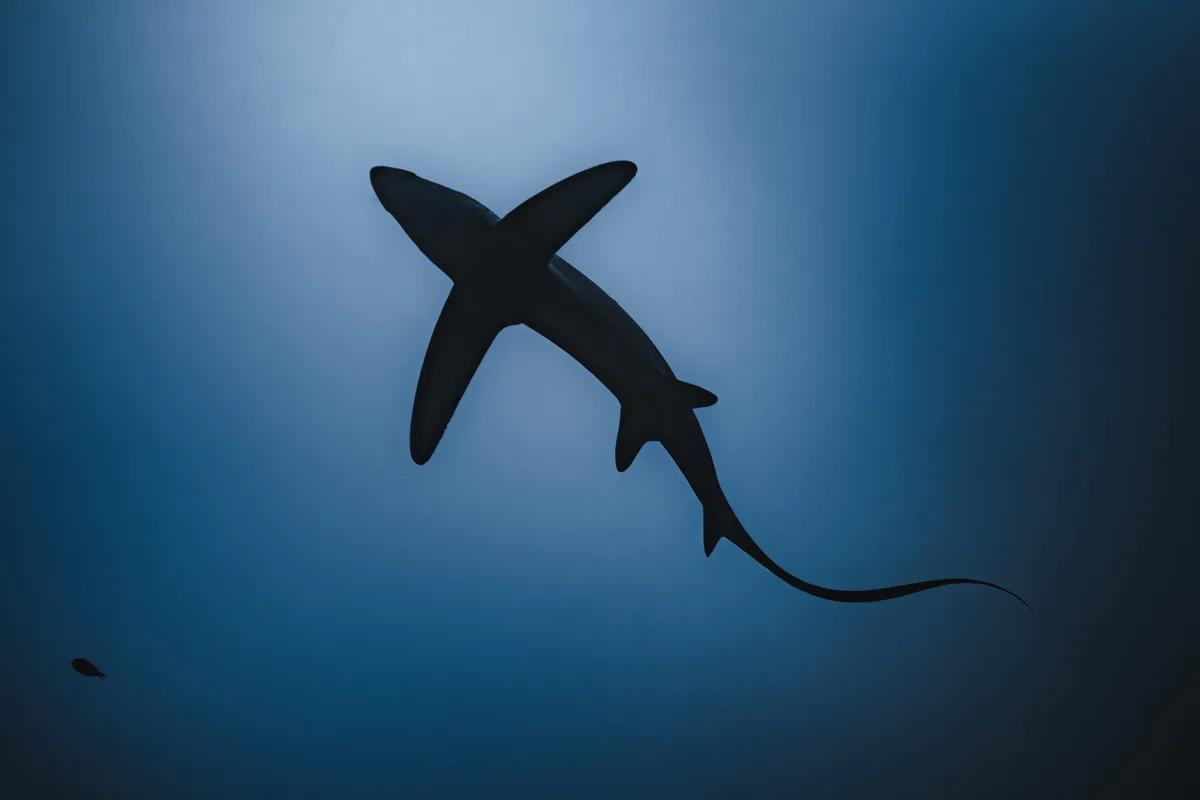
The Pelagic Thresher is easily identified by its metallic silver skin and the exceptionally long upper lobe of its tail fin. Unlike the Common Thresher, the Pelagic species has darker patches above the pectoral fins and no white patch over the gill slits.
In Fuvahmulah, encounters are special because these sharks are typically solitary. Seeing one interact with cleaner fish is a rare glimpse into their vulnerable side. Their large, puppy-like eyes give them a gentle appearance, but make no mistake—they are highly efficient predators.
The Morning Ritual
Every morning, just after sunrise, Thresher Sharks ascend from the abyss to visit the "cleaning stations" located on the reef ledges.
Here, specialized cleaner wrasse fish perform a vital service, removing parasites from the sharks' skin, gills, and even inside their mouths. During this process, the sharks enter a trance-like state, swimming in tight circles with their tails lowered. This is the Golden Moment for divers to observe them at close range.
- Sharks slow down to stall speed
- Pectoral fins drop to signal safety
- Critical hygiene interaction
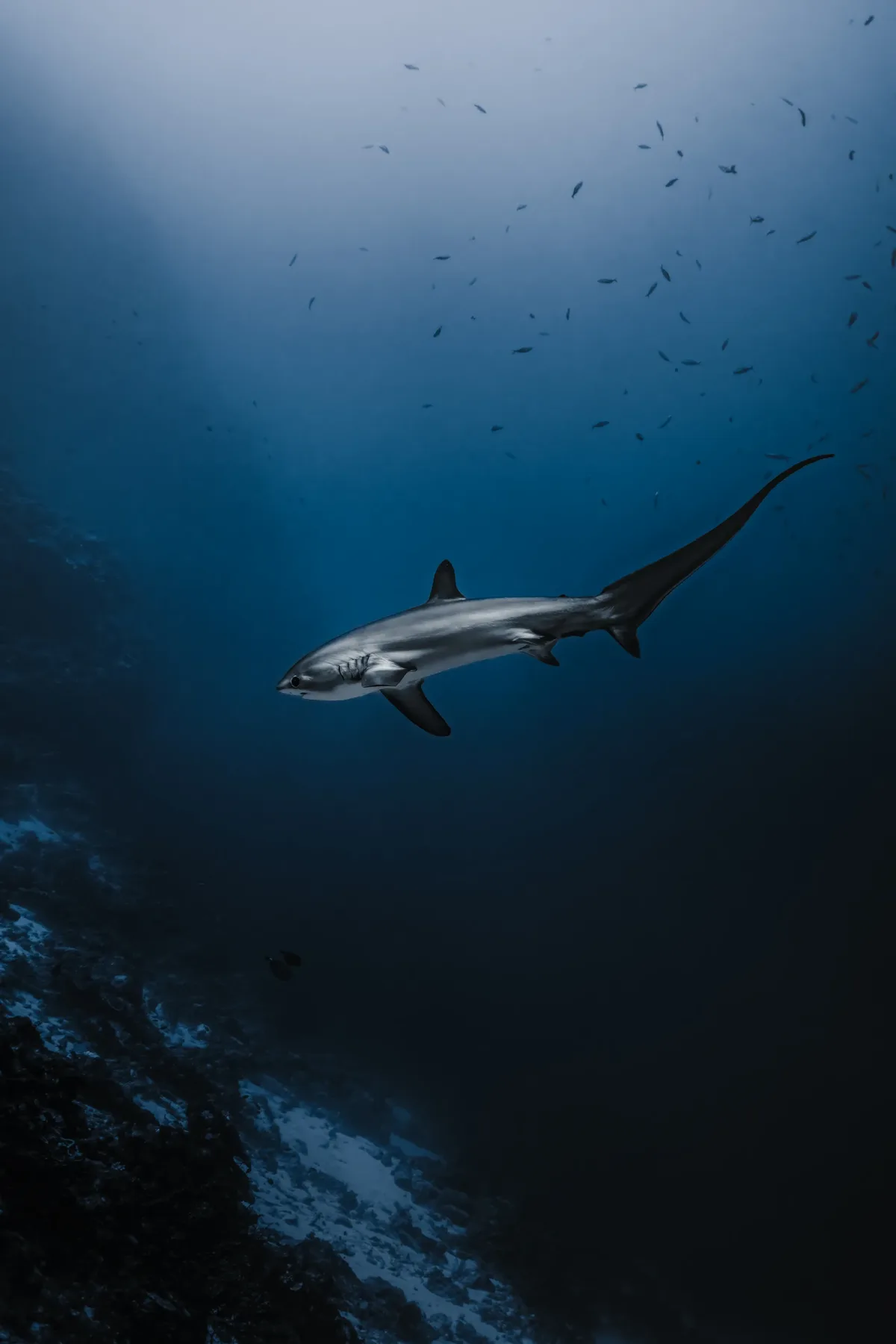
Symbiosis in Action
Cleaner wrasse removing parasites from a Pelagic Thresher.
"We had an absolutely unforgettable experience with Liquid Shark Divers on Fuvahmulah. From the very beginning, the entire team impressed us with their professionalism ans kindness. Everyone was incredibly welcoming, courteous, and highly experienced. What made the experience e…"
Encounter Protocols
Threshers are extremely shy. Following these rules ensures the sharks stay at the cleaning station, giving everyone a better experience.
Stealth Mode
Minimize movement. Keep arms folded. Do not swim towards the shark. Let them approach you.
Stay Low
Always stay below the shark or at eye level. Rising above them blocks their escape route and scares them off.
Light Control
Avoid strobe lights if possible. Their large eyes are sensitive. Sudden flashes often end the encounter immediately.
Navigating the North
While the south of Fuvahmulah is famous for currents, the best sites to spot Thresher Sharks are actually Thoondu and One Palm, located on the North-East tip of the island.
These sites feature sloping reefs with active cleaning stations located at recreational depths (15m - 30m), making them accessible to all Advanced divers. Threshers are also frequently spotted at the cleaning stations along the East Coast reefs.
Thoondu / One Palm
Primary cleaning station sites.
Depth Compliance
All dives strictly limited to 30m max (Maldives Law).
The Thresher Archive
Everything You Need to Know
When is the best time to see Thresher Sharks in Fuvahmulah?
+
The best time is during early morning dives between 6:00 AM and 8:00 AM. Thresher Sharks ascend from deep waters to visit cleaning stations at dawn before retreating to deeper zones. Year-round sightings are possible, but visibility and shark activity are optimal during the dry season (December to April).
What certification level do I need to dive with Thresher Sharks?
+
You need to be an Advanced Open Water diver with experience in drift diving. The cleaning stations are located between 15-30 meters depth, and divers must be comfortable with currents and maintaining neutral buoyancy. We maintain a maximum 4:1 diver-to-guide ratio for safety and to minimize shark disturbance.
How do Thresher Sharks in Fuvahmulah compare to those in Malapascua, Philippines?
+
Fuvahmulah offers a unique alternative to Malapascua. The Pelagic Thresher Sharks here tend to be larger and encounters often include other pelagic species like Hammerhead and Silvertip Sharks. Unlike dedicated thresher sites, Fuvahmulah provides multi-species encounters with less crowding and more solitude at cleaning stations.
Can I use my underwater camera and flash?
+
Cameras are allowed, but we strongly recommend avoiding strobe lights and flash photography. Thresher Sharks have very large, sensitive eyes adapted for deep-water hunting. Sudden bright flashes can startle them and end the encounter immediately. Natural light photography produces stunning results during morning dives.
What are the best dive sites for Thresher Shark encounters?
+
Thoondu and One Palm on the northwest tip of Fuvahmulah are the primary cleaning station sites. These locations feature sloping reefs with active cleaning stations at recreational depths. Thresher Sharks are also frequently spotted along the East Coast reefs. Our guides know the current hotspots and will maximize your chances of encounters.
How many dives are dedicated to Thresher Shark searching?
+
Our first dive of the day is primarily dedicated to searching for Threshers at their cleaning stations. We also look for them during second and third dives, often before or after tiger shark encounters. This multi-dive approach increases your chances of successful sightings throughout the day.
Ready to see the
Unicorn?
Our first dive of the day is primarily dedicated to searching for Threshers at their cleaning stations. We also look for them during second and third dives, often before or after tiger shark encounters. Due to depth limits and currents, we maintain small groups (max 4:1 ratio). Book your dive today.